Tuesday, May 31, 2011

The Myth Maker


Yesterday I finally made it downtown to the National Gallery of Art to see the exhibition Gauguin: Maker of Myth that originated at the Tate Modern in London (it closes next Sunday, June 5). Seeing so many of his pictures together and up close made me realize anew how utterly he created his own version of Tahiti, compete with a made-up mythology drawn from the Javanese, a distorted idea of the great Easter Island statues and his own imagination.
Not that I blame him for it – he had a perfect right to paint an invented world that did not correspond with what lay in front of him. My only concern is that the entire conception of Tahiti for most people in the modern West hangs on this man’s images. And while these images are extraordinary, unique, and powerful, they are not to be fully trusted as true depictions of the Tahiti of the 1890s. I speak of course as someone who is writing about that very period in Tahiti’s rich history and is taking great pains to make sure the picture that I am painting is true to life.  
When Gauguin arrived in Papeete, the capital, in 1891, he was disgusted by what he found. ”It was Europe – the Europe which I had thought to shake off… the imitation, grotesque even to the point of caricature, of our customs, fashions, vices, and absurdities of civilization. Was I to have made this far journey only to find the very thing which I had fled?” He was momentarily distracted by the funeral of King Pomare V whose liver had finally given way after years of gargantuan alcohol consumption. At the palace, Gauguin was introduced to the 31-year-old ex-Queen Marau, and he waxed lyrical in his book Noa Noa about her “Maori charm” and the “truly imposing grandeur” of herself and her brother Tati Salmon, whom he heard give the oration at the King’s funeral.  
Despite these intriguing encounters, Gauguin soon found he was persona non grata with the French authorities and fled down the west coast of the island – beyond the reach of the civilization he decried – to the village of Mataiea. There he rented a bamboo hut, intending to live like the local Tahitians on breadfruit and fish from the lagoon. But he found it harder to shed the trappings of “civilization” than he had thought. In reality, he lived on canned goods that he bought on credit at the local Chinese-run village store and sent endless letters home to his wife and friends and his art dealer complaining of his penury. “I am a great artist, and I know it. It is because I am what I am that I have to endure so much suffering... What annoys me is not so much the misery but the fact that constant obstacles are put in the way of my art so that I cannot do what I feel and that I should be able to do it without the misery that is always tying my hands.”
His only consolation was to paint the great mythic visions that he saw in his head – images of Tahitian Eves and young girls terrified by lurking tupapau (evil spirits) and an entire pantheon of gods and goddess half-invented and half-borrowed from the religions of the East.  
Yet as much as this Tahiti is of Gauguin’s own invention, as I walked around the galleries yesterday, I caught glimpses of the Tahiti I have come to know – both through books and in person. I have seen the lovely faces of the girls in Two Tahitian Women in the streets of Papeete, and I have seen the same view inland towards the mountains with a foreground full of coconut palms and breadfruit trees and a man carrying bunches of wild bananas on a long pole as in Tahitian Mountain Landscape. I even spotted the chickens and the scrawny dogs that are everywhere in Tahiti even more than a century later.
So maybe it doesn’t matter that Gauguin didn’t paint a literal picture of the place and the period. While the facts do matter, sometimes an oblique view can illuminate it even more.  

Tuesday, May 24, 2011

From the Spreading South Seas


An American traveler to Tahiti before the First World War describes Lovainia – the proprietress of the Tiare Hotel in the capital, Papeete.
“The Tiare Hotel was the center of English-speaking life in Papeete. Almost all tourists stayed there, and most of the white residents other than the French took their meals there... It was a one-storied cottage, with broad verandas, half hidden in a luxuriant garden at the point where two streets come together at a little stone bridge crossing a brook – a tiny bungalow built for a home and stretched and pieced out to make a guest-house.
Papeete... was a quiet little town... What exotic life there was… revolved around the Tiare and entirely so because of its proprietress, Lovainia. She was the best-known and best-liked woman in all these South Seas, remembered from Australia to the Paumotus, from London to China, wherever were people who had visited Tahiti as ‘dear old Lovainia.’
She was very large. She was huge in every sense, weighing much more than three hundred pounds, and yet there was a singular grace in her form and her movements. Her limbs were the girth of breadfruit-trees, and her bosom was as broad and deep as that of the great Juno of Rome, but her hands were beautiful, like a plump baby’s, with fascinating creases at the wrists and long, tapering fingers. Her large eyes were hazel, and they were very brilliant when she was merry or excited. Her expansive face had no lines in it, and her mouth was a perfection of curves, the teeth white and even. Her hair was red-brown, curling in rich profusion, scented with the hinano flower, adorning her charmingly poised head in careless grace.
When she said ‘I glad to see you,’ there was a glow of amiability, an alluring light in her countenance, that drew one irresistibly to her, and her immense, shapely hand enveloped one’s own with a pressure and a warmth that were overpowering in their convincement of her good heart and illimitable generosity.”
The ordinary life of the Tiare Hotel was all upon the broad verandas which surrounded it, their high lattices covered with the climbing bougainvillea and stephanotis vines, which formed a maze for the filtering of the sunlight and the dimming of the activities of the streets. On these verandas were the tables for eating, and in the main bungalow a few bedrooms, with others in detached cottages within the enclosure.
A small porch [was] approached from the street by a few steps. On this tiny porch was a large table, and behind it a couch. The table was the only desk for letter-writing, the serving stand for meals, the board for salad and cake-making, and the drink bar. A few feet removed from this table and against the wall was a camphor-wood chest on which two might sit in comfort and three might squeeze at angles. In the chest was all kept the bed and table linen, so that one might often be disturbed by the quest of sheets or napkins.
This little porch… was the sleeping and amusement quarters of five dogs, the loafing places for the girls, the office of the hotel, the entry for guests to the dining room... Through it streamed all who came to eat or drink or for any other purpose.”
On the couch at the back of the table Lovainia sat for many hours every day. Her great weight made her disinclined to walk, and from her cushions she ruled her domain, chaffing with those who dropped in for drinks, advising and joking, making cakes and salads, bargaining with the butcher  and vegetable-dealer, dispatching the food towards the tables, feeding the many dogs, posting her accounts, receiving payments, and regulating the complex affairs of her ménage. She would shake a cocktail, make a gin fizz or a Doctor Funk, chop ice or do any menial service, yet withal was your entertainer and your friend.
Underneath the table dogs tumbled or raced about the porch, barking and leaping on laps, cats scurried past, and a cloud of tobacco smoke filled the close air. Lovaina, in one of her sixty bright gowns, a white chemise beneath, her feet bare, sat enthroned. On the chest were the captain of a liner or schooner, a tourist, a trader, a girl, an old native woman, or a beachcomber with money for the moment. It was the carpet of state on which all took their places who would have a hearing before the throne or loaf in the audience chamber.
In her low, delightfully broken English, in vivid French, or sibilant Tahitian, Lovainia issued her orders to the girls, shouted maledictions at the cook, or talked with all who came. Through that porch flowed all the scandal of the South Seas – tales of hurricanes and water spouts, of shipwrecks, of accidents, of lucky deals in pearls or shells, of copra, of new fashions and old inhabitants, of liaisons of white and brown, of the flirtations of tourists, of the Government’s issuing an ultimatum on the price of fish, of how the consuls quarreled at a club dinner, and of how one threw three ribs of roasted beef at the other, who retorted with a whole sucking [sic] pig just from the native oven, of Thomas’s wife leaving him for Europe after a month’s honeymoon; and all the flotsam and jetsam of report and rumor, of joke and detraction, which in an island with only one mail a month are the topics of interest... The porch was the clearing-house and the casual, oral record of the spreading South Seas.”
Frederick O’Brien, “Mystic Isles of the South Seas,” The Century Company, 1921

Friday, May 13, 2011

A language lament

That's me on the right with the pen
I have always been a big fan of National Public Radio. I listen every day and greatly admire the station’s consistently incisive reporting and its coverage of international issues beyond the immediate sphere of American interests. So it grieves me to have to say – with my editor hat on (not that it’s ever off) – that NPR has become downright sloppy in its use of the English language.
I’m not talking about colloquialisms, which play a legitimate part in contemporary spoken English. I’m talking about big-time grammatical no-nos.  The fact that many of these are legion throughout the journalism world doesn’t cut any ice with me. I had hoped NPR would hold itself to a higher standard.
The first and most pervasive error is the widespread missing out of prepositions. Instead of saying that so-and-so “provided me with information,” the correspondent invariably says “provided me information.” Nor do I ever hear anyone say that a statistic is “up by 50 percent” – no, it’s “up 50 percent.” Another one that drives me crazy is when reporters say that someone is “suffering mental illness” instead of “suffering from mental illness.” What is this compulsion to shorten every sentence to the fewest possible words?
The second of my pet peeves is the widespread inability to know when to use an adverb instead of an adjective: “Where they’ve operated strongest” instead of “most strongly.” Adverbs are a generally tricky subject in this country. Everybody eats “more healthy” instead of “more healthily.” I’m all for simplicity of language but not when it makes no sense.
And then there is the vexed question of dangling modifiers. In the aftermath of the terrible shooting of Congresswoman Gabrielle Giffords in January of this year, I gasped in disbelief when I heard one NPR correspondent saying, “Shot in the head two weeks ago, doctors say that Congresswoman Giffords… blah, blah, blah.” According to that sentence, it was the doctors who were shot in the head, not Ms. Giffords. I hear this kind of blooper all the time on NPR, not just when reporters are talking off the cuff but in prepared, pre-taped reports. Why did no one in the chain of command hear it and say: ”That’s not correct”? Is it because no one – not even the well-educated professionals at National Public Radio – actually knows a dangling modifier when they see one any more?
In case anyone thinks I’m singling out American journalists, consider my all-time favorite blooper from a report on a hybrid animal: “A cross between a llama and a camel, scientists say the lamel blah, blah, blah…” That beauty was broadcast on the venerable BBC. It’s enough to make an editor break her red pen over her knee and go off to live in a cave.

Tuesday, May 3, 2011

She's out there somewhere...


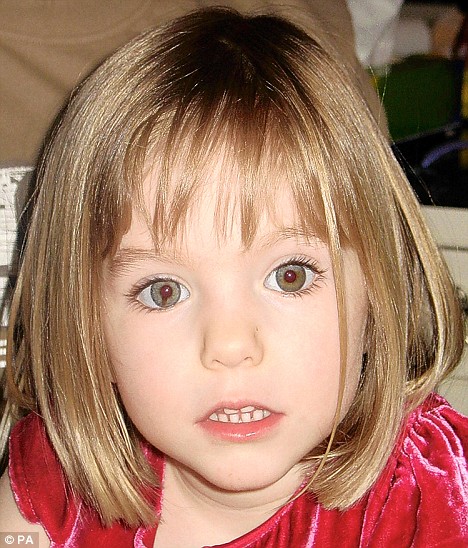
Four years ago today, a little British girl, Madeleine McCann, was snatched from her bed at her family’s holiday villa in Praia da Luz, Portugal and hasn’t been seen since.
The Portuguese police completely botched the investigation – they didn’t take any fingerprints till it was too late and failed to close either the ports or the border to Spain. After several months, embarrassed by adverse press reports, they turned on Madeleine’s parents, two doctors from Leicestershire, and made them official suspects or arguidos in the disappearance and presumed death of their own daughter. How they had to fight to clear their names and turn the attention of the police and judiciary back to looking for Madeleine is told in a new book written by Madeleine’s mother, Kate McCann. It will be published on May 12th, Madeleine’s 8th birthday. Kate’s sole intention in writing the book is to raise enough money to continue the family’s private search for Madeleine.  
I won’t rehash the whole story here because some of you know it as well as I do (and for those who don’t, click here). The crux of the matter four years on is that it seems increasingly likely that Madeleine was stolen to order, either for a pedophile ring or – we must hope – for some kind of illegal adoption service. If this is true, then she is probably still alive somewhere in the world. However much her appearance may have changed, the unique mark in her right eye will still be there.
So please never stop looking into the eyes of all the children you see. One day someone will notice that mark and will start asking the questions that will finally bring Madeleine home.  

Wednesday, April 27, 2011

Hosing down a Princess

Lena Kara, Rex Features

In case anyone had any doubt, I’ll be getting up at 4am on Friday to watch William and Kate’s wedding. I’m sure it will be a very joyous occasion with all the glorious trappings that the Brits do so well - horses and carriages and soldiers in crested helmets and breastplates and miles and miles of flags and bunting and the bells of Westminster Abbey pealing. But like millions of other people, I’ll be thinking how very sad it is that William’s mother will not be there in person to watch her son get married.   
As we all know, Diana, Princess of Wales, died in a high-speed car accident in the Pont de l’Alma Tunnel in Paris on August 31, 1997. While it is now pretty well indisputable that the main cause of that terrible accident was the extreme inebriation of the driver, Henri Paul, I for one have never felt able to absolve the paparazzi from blame.
I have never forgotten an article I read in the British Sunday newspaper, The Observer, the day after Diana’s funeral on Saturday September 6.  Among the acres of tributes and analyses of her impact on the monarchy, there was a short piece by a journalist by Marianne MacDonald which described in brutal detail what Diana had gone through at the hands of the “paps.” Three months earlier, MacDonald had gone on a ride-along with one of the most persistent of the “snappers”, Mark Saunders, and had come away completely sickened by what she had seen.
“I hadn’t cared that much about Diana before. After I spoke to Saunders – and read his book about stalking her – I felt so angry, appalled by what she was left to endure by the rest of the world… It wasn’t a civilised business being at the end of those long lenses. Diana, a woman very often on her own, was constantly followed by a swarm of ruthless, hostile strangers. They surrounded her car, jostled her in the street and insulted her to her face, even though she had paid for the shirts on their back and the beers in their fridge… Once she was held at bay in a taxi. She hid her head. A photographer shouted at her, ‘Put your fucking head up and start acting like a fucking Princess!’” 
According to MacDonald, the predominantly male paps used to describe what they did to Diana as “hosing her down” or “banging her” or even “whacking her” - language that is overtly violent,   sexual, and utterly violating. As MacDonald said, “They couldn’t seem to think of her as a human being. In the adrenaline of the chase she simply became prey to be hunted down.”
This is why so many celebrities came out and blamed the paparazzi immediately after she died in that tunnel in Paris. These were other people who knew what it was like to be the quarry in a desperate manhunt that was all about money.
In an interview with the New York Times after the Princess’s death, Mark Saunders and the co-author of his book, Glenn Harvey argued that Diana had no right to expect privacy when the public had such an appetite for her pictures. The paps also tried to argue that Diana really liked the attention and was a master manipulator of the media, thus resorting to the age-old excuse of the sexual predator – the woman was asking for it.

Kate Middleton has faced her share of over-eager, intrusive paparazzi during her long romance with Prince William, and in agreeing to become his wife, she knew that she would never have a truly private life again. But one can only hope like crazy that the snappers will treat Princess Catherine with a lot more respect than they ever gave her late mother-in-law-to-be.

Friday, April 22, 2011

Who do we think we are?


Recently my husband and I have been trying not to miss “Who Do You Think You Are” on our local NBC station on Friday nights. It’s an import from Britain (like many good things – ha!). The premise of the show is that we the viewers join celebrities as they trace back their family trees and search for the stories behind the bare bones of their ancestors’ lives. Because each search invariably leads through libraries and record offices, the show is able to highlight the essential work done by archivists across the land, from the smallest town hall all the way up to the Library of Congress. It also makes it clear just how much raw historical material is now available online, particularly through Ancestry.com, with a few clicks of a mouse.
Above all, what the program shows vividly every week is that there are millions of stories to be discovered in the past and that every apparently simple family has had its monumental dramas and startling secrets. Some of the programs go back far back into the celebrity’s family tree whereas and others are more recent, but all are equally affecting, not just to the celebrity in question but vicariously to us – the viewers - as well. Sarah Jessica Parker  learned that her 10th great-grandmother was accused of witchcraft during the Salem witch trials. Steve Buscemi found out that his great-great grandfather, as an impoverished young man, had contemplated suicide but thought better of it and went on to marry and have children. Kim Cattrall set out to find out what had become of her grandfather after he had walked out on his family and was able to tell her mother and aunts that she’d discovered that they had several half-siblings alive and well in Australia.
Each celebrity to one degree or another seems to feel like they’ve discovered something not only about themselves in the course of the search but also about the currents of history. Events that may have seemed impersonal and distant to them came through their search to have an immediacy and a relevance for them that they had never had before.
This capacity to bring history into focus is why I have always been a huge fan of genealogy – that and the fact that it is as addictive as any other kind of puzzle-solving can be. As you gradually gather together the clues – the birth certificates and parish records and newspaper cuttings – the person’s story starts to reveal itself in the interstices of the material.
I have done a certain amount of work on my own family tree, building on the work of others before me for whom it was a much more arduous and time-consuming task in those pre-Internet days. But the most intensive genealogical sleuthing I’ve done has been for Children of Eden.
I made two big discoveries. Quite by accident, I found that Alexander Salmon was not in fact descended from a family of prosperous Jewish bankers as his children had believed. After consulting the English censuses online at Ancestry.com, the birth, marriage and death records at the National Archives in London , and the business advertisements in the London Gazette, I found that Alexander’s origins were rather more humble than those he had claimed. His father was a perfectly respectable “fruiterer” or greengrocer with a shop on Piccadilly. Although the family lived check by jowl with the nobility, they were firmly consigned to the merchant class, and their Jewishness put them further beyond the pale of the English middle class of the time.
So who could blame Alexander for gussying up his background a little once he got to Tahiti, especially given the way he was treated by some of the established European settlers and visiting naval captains. To give one example, Captain Henry Byam Martin, commander of HMS Grampus, which called in at Tahiti in 1847, described Salmon in his ship’s log as, “... a low swindling bankrupt Jew from London.” It’s gratifying to imagine how galling it must have been for such people when the upstart Jew married the sister of the Queen of Tahiti.
My second discovery was that, on his mother’s side, Alexander was a grandson of a renowned Jewish miniaturist artist, Solomon Polack, who was a friend of William Thackeray (the author of Vanity Fair) and was famous for having been one of the few people considered devout enough to be admitted to the prison cell of the Jewish convert, Lord Gordon, and allowed to sketch his likeness.
Polack’s daughter Catherine was Alexander’s mother, but I also discovered that Polack had one son who was sent as a convict to Australia but was freed and became one of the biggest landowners in the Sydney area and another son who was one of the earliest settlers in New Zealand and wrote two books on his experiences working with the Maoris. Talk about unearthing a totally unexpected set of larger-than-life characters! So I’m thinking, after I finish Children of Eden, maybe writing the story of the Polack family may just have to be next on my list… till the next great story comes along.

Tuesday, April 19, 2011

Back to basics

“What a vast fertility of pleasure books hold for me! I went in and found the table laden with books. I looked in and sniffed them all. I could not resist carrying this one off and broaching it. I think I could happily live here and read forever.” Virginia Woolf, August 24th, 1933

There have been times in my life when I couldn’t read. I’m in one now. Too much anxiety and work and required reading and not enough time or concentration. It’s not a good feeling. It’s like I imagine it would be to have to navigate the world with only one eye or ear – making everything seem slightly off-kilter. It saps my energy just as the lack of sleep or losing my appetite would do. My soul cannot consume what it needs to survive. 
When I say I can’t read, it doesn’t mean I don’t try. I pick up books and start reading a chapter only to find my mind slipping off the page. I start fretting about what work I need to get done tomorrow or what medicine to give my sick cat. My imagination refuses to latch onto the story and let itself be pulled under. 
The last time I went through a patch like this, my friend Page, who is at least as voracious a reader as I am, gave me some good advice. She said, “Go back to basics, to most comforting books you know.” For her, that is anything by Dickens or Jane Austen. It seemed like good advice, but I wasn’t sure what my equivalent would be, a book worn smooth with familiarity like a childhood teddy bear or blankey. And then I remembered how in my early 20s I had devoured the Diaries of Virginia Woolf as I crossed London every morning on the top deck of the No. 6 bus. Mired in the problems inherent in my first grown-up job, I was encouraged by the struggles that the great novelist herself had gone through – with depression and lack of confidence – even as she devoted herself to the steady, disciplined writing of her ground-breaking novels.  
So I plunged back into the diaries and found myself similarly inspired and soothed 30 years after I first read them. Problem solved. As Page had predicted, my reading drought was over and I went back to consuming books of all kinds at my usual breakneck pace. Not one to mess with success, this time around I’m thinking of turning to Woolf’s Collected Letters, which sit in a neat row of pastel spines on my shelf waiting for my middle-aged self to take them down again. What books would you turn to in a drought?