Friday, July 25, 2014

The Joy of the Receiving World


Still from Death in Venice, 1971

Death in Venice is my all-time favorite movie (you can watch the whole movie on YouTube here). In this 1971 film directed by the Italian director Luchino Visconti, Dirk Bogarde gives a subtle and moving performance as the aging composer Gustav von Aschenbach who comes to the Venice Lido for a rest cure in the years before the First World War. The haunting cinematography is underscored by the glorious music of Mahler’s 3rd and 5th Symphonies, particularly the Adagietto from the Fifth Symphony, which is perfectly in synch with Aschenbach’s emotional journey.

Aschenbach becomes enchanted by a beautiful young Polish boy, Tadzio, who is staying at the same hotel (the Grand Hotel des Bains, which still exists though it is now being turned into luxury apartments). As the older man falls more and more under the boy’s spell, he becomes increasingly aware that the authorities are covering up evidence of a growing cholera epidemic in Venice, and his pursuit of Tadzio becomes more reckless as he fears for the boy’s life.

Visconti and his cinematographer Pasqualino De Santis created beautiful images of the beach that are reminiscent of the paintings of Eugène Boudin, with ladies’ parasols clustered by the edge of the sea and their draperies fluttering in the breeze off the Adriatic. 
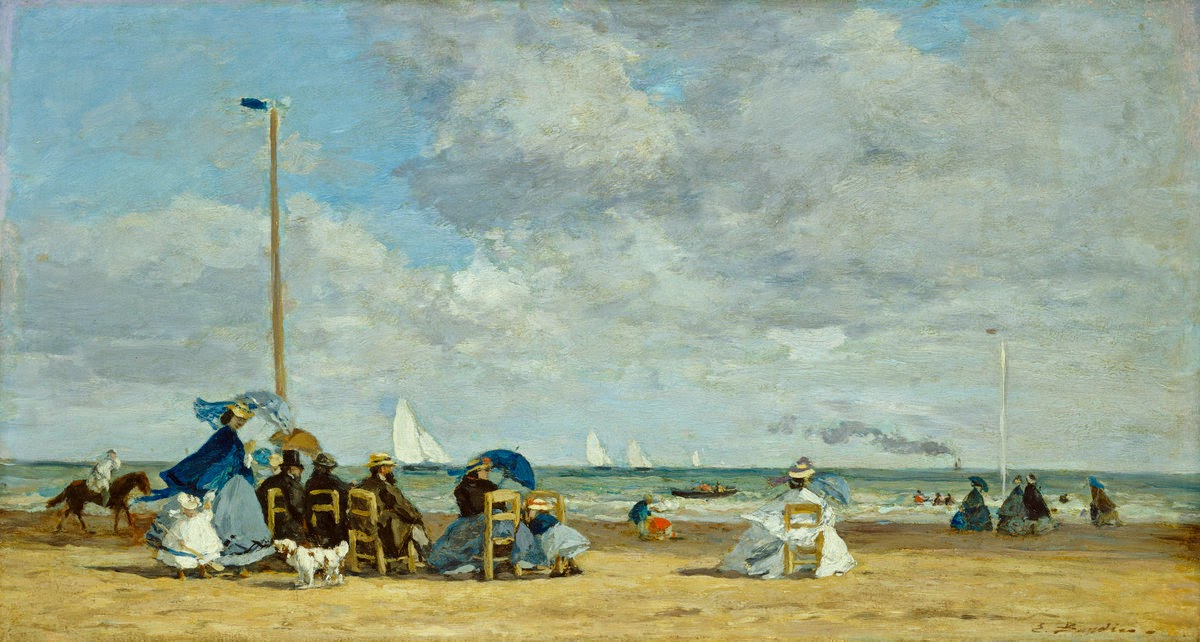
On the Beach at Trouville, Eugene Boudin, 1864
Still from Death in Venice, 1971

The movie is based on the short novel by Thomas Mann of the same name. This is how Mann describes Aschenbach’s first morning on the Lido beach:

“The shallow grey sea was already gay with children wading, with swimmers, with figures in bright colors lying on the sand-banks with arms behind their heads. Some were rowing in little keelless boats painted red and blue, and laughing when they capsized. A long row of capanne [huts] ran down the beach, with platforms, where people sat as on verandas, and there was social life, with bustle and with indolent repose; visits were paid, amid much chatter, punctilious morning toilettes hobnobbed with comfortable and privileged dishabille. On the hard wet sand close to the sea figures in white bath-robes or loose wrappings in garish colors strolled up and down.  A mammoth sand-hill had been built up on Aschenbach’s right, the work of children, who had stuck it full of tiny flags. Vendors of sea-shells, fruit, and cakes knelt beside their wares spread out on the sand.”    
Visconti’s movie is a faithful adaptation of Mann’s story except that in the book Aschenbach is a writer rather than a composer. And his reason for going to Venice is a growing fatigue with his disciplined writing life, which has made him feel oppressed by the “care and duty to create.”   
"He thought of his work, and the place where yesterday and again today he had been forced to lay it down, since it would not yield either to patient effort or to a swift coup de main. Again and again he had tried to break or untie the knot – only to retire at last from the attack with a shiver of repugnance. Yet the difficulty was not actually a great one; what sapped his strength was distaste for the task, betrayed by a fastidiousness he could no longer satisfy. In his youth, indeed, the nature and inmost essence of the literary gift had been, to him, this very scrupulosity; for it he had bridled and tempered his sensibilities, knowing full well that feeling is prone to be content with easy gains and blithe half-perfection. So now, perhaps, feeling, thus tyrannized, avenged itself by leaving him, refusing from now on to carry and wing his art and taking away with it all the ecstasy he had known in form and expression. Not that he was doing bad work. So much, at least, the years had brought him, that at any moment he might feel tranquilly assured of mastery. But he got no joy of it – not though a nation paid it homage. To him it seemed his work had ceased to be marked by that fiery play of fancy which is the product of joy, and more, and more potently, than any intrinsic content, forms in turn the joy of the receiving world.”  
The unspoiled perfection of Tadzio brings back to the jaded writer the "ecstasy" that makes a book (or symphony or painting) resonate with an audience and fills them with the same joy with which the book was created. Unfortunately for Aschenbach, the cholera overtakes him before he is able to put this new passion into his work. He dies in his deck chair with his face turned towards Tadzio who, standing waist-deep and sunlit in the glittering water, "pointed outward as he hovered on before into an immensity of richest expectation." 


Friday, July 18, 2014

The History of Yesterday

A cameraman filming a masked IRA gunman, 1972 (courtesy of the BBC)


I’ve recently been rereading and editing my first novel, The Province of the Imagination. It’s set in the mid-1980s in the thick of the Troubles in Northern Ireland. It draws on my own brief experience in Belfast as a journalist at that time, though the heroine – Sandie Gillespie – is much braver and more successful than I ever was. 


I wrote the novel around the time that Senator George Mitchell was bringing together the warring parties in a peace conference that culminated in the signing of the historic Good Friday Agreement in April 1998. By the time I sent the novel out to agents and publishers, they turned it down because “the Troubles are old news” and “people are tired of hearing about it.”  


So now, more than 15 years later, I am getting ready to send the manuscript out again, but this time as a historical novel. Yes, the 1980s are now officially history. And it shows in the smallest details in the novel – the need to find a phone box, the unlocking of each car door separately with a key, the typing of a script on a bulky typewriter, and the total absence of computers, cell phones, the Internet, social media – all the technological changes that have revolutionized the world in the 30 years since 1985.


Journalism was a matter of old-fashioned shoe leather and face-to-face interviews with no DNA matching or worldwide information databases. Looking back, I remember I didn’t even own an answering machine, even though I was getting calls from Cabinet Ministers and other senior politicians at my home. This is the low-tech world in which TV reporter Sandie Gillespie, nursing a broken heart, and her over-protective producer Bob, who’s in love with her, try to find out who assassinated the leader of Sinn Fein, the political wing of the IRA. As they weave their way through the labyrinthine and violent political world of the Province of Ulster in the never-ending rain, no one will give them a straight answer and they discover that nothing and no one is quite as it seems. 


Friday, June 27, 2014

Abby and the Astronaut


I’m delighted to report that I have a short story in District Lines, a new anthology of stories, essays, and poems about Washington D.C. produced by the famous Politics & Prose bookstore frequented by Presidents. You can order it here. In the meantime, here’s my story:


Abby and the Astronaut


Abby was in the Air and Space Museum. She was looking at a photograph of three young men in bulky space suits grouped around an enormous Presidential seal. Only one of them could really be called handsome, with a sculpted jaw and eyes as blue as oceans seen from space. Suddenly aware of someone at her shoulder, Abby turned and found herself looking into that very face. The hair had receded to almost nothing, but there was no mistaking those eyes.
“Hi.”
He held out his hand. She shook it.
“Aren’t you...?”
“I’m Chuck B. Anderson. I went up in Zephyr III. And who are you?”
Chuck wore a turtleneck and a tweed jacket, and his waist was flat above the belt of his Chinos. He took Abby to lunch in the glass atrium of the Museum=s restaurant. Beyond the roar of voices in that echoing space, the Capitol dome levitated in the heat haze. Over their empty salad plates, the Astronaut reached for Abby=s hand and pulled gently at the webs of skin between her splayed fingers.

Everywhere in the city there were statues of celebrated men. Abby had taken them all in – Lincoln magisterial on his massive chair, Jefferson in his giant gazebo, handsomer than in life, the long-legged Andrew Jackson on a prancing horse in Lafayette Square, waving his cocked hat at the White House. They even walked the streets in flesh and blood. Pausing with his aides at a crosswalk on the Senate side, Ted Kennedy turned to watch Abby’s legs as she walked past, while she tried not to stare at that unmistakable florid face. 
There were no famous people where Abby hailed from. Whatever happened happened somewhere else. At night Main Street was deserted. All the streetlamps had to shine on was the row of empty pick-ups outside Erikkson’s bar and the metallic walls of Lundgren’s creamery, which loomed over the town like an ocean liner in dry dock.

Chuck’s apartment was the closest, down near the marina in South West. He drove her there in his silver Miata. A fountain ejaculated in the lobby of his building. The elevator was lined with mirrors, and when Abby looked up, she had a bird’s-eye view of the crown of his head. It looked rosy but hard, like a nut.
In his apartment, every flat surface held an enormous crystal. Abby picked one up and ran her fingers over its facets. 
“What are they supposed to do?” she asked, passing the rock of rose quartz from hand to hand. Chuck took it away from her and put it back on its shelf.
“You can damage their auras if you hold them too long.”
In the bedroom, Chuck closed the drapes and lit the candles ranged across his dresser as Abby perched on the edge of the bed, swinging her heels. Shaking out the match, Chuck shrugged off his jacket and came towards her.
As a girl, Abby had dreamed of being ravished by a centaur. She’d raise her legs under the covers and run her hands down the human chest and onto the coarse warmth of the creature’s hide. What she’d wanted was to have something mythical between her thighs. Nothing less would do. 
So when Chuck B. Anderson gently tipped her onto her back, she closed her eyes and let herself be entered by a legend.
 
#####


Tuesday, June 10, 2014

At the Going Down of the Sun


Almost 6 million men from the British Isles fought for their country in the Great War of 1914 to 1918. There can't be many British families who didn't have at least one member who served. Both my grandfathers were too young, but my great-uncle John Charles Teasdale (Jack) Mackintosh answered the call. 

Uncle Jack was born in 1893, the eldest child of John Teasdale and Madeline Foister. The family lived in Dalkeith just outside Edinburgh, from where young Jack’s father ran the Scottish branch of the family's mapmaking business. They were a typical prosperous, middle-class family of the late Victorian age until February 1902 when John Teasdale died unexpectedly of heart failure, aged only 35. 

Jack’s mother Madeline (my great-grandmother) had to become the breadwinner for four children under the age of nine. She had been trained as a teacher and for the next 25 years earned her living as a schoolmistress in various small rural schools all around the Midlands and southern England. It was always a struggle to make ends meet. (In the picture above Jack is standing behind his sister Dorothy (Dodo), brother Malcolm, and youngest sister Edina (Ina) outside the school house at Kirkby Mallory in Leicestershire - one of their mother's placements.)

In 1914 Jack was 21 and was training as a teacher to follow in his mother’s footsteps. When war was declared on August 4th, like many other young men all across Britain he rushed to enlist. At the Drill Hall in Nottingham he was signed up for the Nottinghamshire and Derbyshire Regiment (otherwise known as the Sherwood Foresters). The picture on the left shows Jack in his uniform as a private. It was taken in December 1914 in Luton near where his unit was training.  He sent it as a postcard “To all at home with love and good wishes for the New Year.” 

In late February 1915, Jack’s unit - the 1/7th (Robin Hood) battalion - was part of the first Territorial division to be sent to France. The unit was involved in the defense of the Belgian chateau of Hooge in July 1915 and then in the losing British assault on the Hohenzollern Redoubt during the Battle of Loos on the 13th October 1915. A soldier who went through that action described it as: "absolute hell with the lid off. Dying and wounded all over the place. Shall never forget this day."

And the Robin Hoods were in action on the terrible first day of the Somme - July 1st, 1916. In the attack on the Gommecourt Salient, the battalion lost 424 officers and men, including 181 of the men who had enlisted with Jack in Nottingham on the first day of the war. 

Three times he could have been killed and three times he escaped with his life, not to mention all the sniping and shelling in between.And yet he came home not just alive but miraculously uninjured.

At some point, Jack was transferred to the 2/1st Staffordshire Yeomanry, which stayed on English soil for the remainder throughout the war. The picture below of Jack on horseback was taken at Leybourne Camp in Kent in June 1917. A couple of months later the 2/1st was converted into a cyclist unit, moving first to Tonbridge and then to Canterbury where Jack met the young woman he would marry, Gladys Heaton. 


 After the war, Jack became a teacher of English and French at Robert Mays Grammar School in the lovely Hampshire village of Odiham. He and Gladys had no children of their own, but Jack adored his nieces and nephews. His nephew Ian (my father) remembered Uncle Jack as having a great sense of fun. Together they used to flush paper boats down the toilet and then rush out to the garden see the boats emerge in the cesspit. Like many veterans, he never spoke of what he experienced as a soldier in the trenches. He must have known he was lucky to have survived and perhaps that's why he threw himself into his civilian life with gusto. In the picture below taken in his garden in Odiham, he is dressed up as a mother with his younger brother Malcolm (my grandfather) as the baby.


Even though he survived the trenches by 20 years, Jack's life was nevertheless to be tragically and brutally cut short. On the night of November 29th 1937, he and Gladys were driving home from Winchester. On Kempshott Hill outside Basingstoke, Jack got out of the car to clear ice off the windshield. A car coming from the other direction driven by a man who had been drinking heavily all evening struck Jack so hard that his head was all but severed from his body. He was only 44 years old. 

He was buried in Odiham and his funeral was attended by the entire staff and pupils of the Robert Mays School. The cortege was preceded by members of the Odiham branch of the British Legion carrying their standard draped in crepe, which was dipped in respect as the coffin was lowered into the grave.  After the Vicar had said the last woods of the Anglican burial service, the chairman of the branch recited the British Legion exhortation from Lawrence Binyon’s poem “For the Fallen”:
 

They shall grow not old, as we that are left grow old:
Age shall not weary them, nor the years condemn.
At the going down of the sun and in the morning
We will remember them.


Wednesday, May 21, 2014

The Jazz Age on the Grand Canal

Coco Chanel (seated left) and friends on the Lido, 1925


When I first dipped into Lady Chatterley’s Lover in my schooldays, it was simply to find the scandalous passages that had kept the full text from being published for 32 years. On reading the novel properly for the first time recently, I found it to be vintage D.H. Lawrence - full of passion for nature and unmediated human emotion and against the mechanized, industrial spirit of his age. About two-thirds of the way through the novel, even though the heroine Constance Chatterley is deep in the throes of her sexual awakening with the gamekeeper Oliver Mellors, she goes off to Venice on a holiday with her father and sister. Lawrence clearly intended the episode to represent the antithesis of everything that Constance has had with Mellors - the simplicity and sometimes brutal honesty of their connection with each other in the woods of Wragby Hall. 

And one can see why. Venice in the 1920s was a pleasure ground of the rich, mixing the beaches of the Lido with the fascination of a city of ancient palaces built on water. It was hedonistic, decadent, and lavish – and almost too rich a feast to be digested. 


“There were illuminated water-fêtes, there were dances. This was a holiday-place of all holiday-places. The Lido with its acres of sun-pinked or pyjamaed bodies, was like a strand with an endless heap of seals come up for mating. Too many people in piazza, too many limbs and trunks of humanity on the Lido, too many gondolas, too many motor-launches, too many steamers, too many pigeons, too many ices, too many cocktails, too many men-servants wanting tips, too many languages rattling, too much, too much sun, too much smell of Venice, too many cargoes of strawberries, too many silk shawls, too many huge, raw-beef slices of watermelon on stalls: too much enjoyment, altogether far too much enjoyment. ... It was pleasant in a way. It was almost enjoyment. But anyhow, with all the cocktails, all the lying in the warmish water and sunbathing on hot sand in hot sun, jazzing with your stomach up against some fellow in the warm nights, cooling off with ices, it was a complete narcotic. And that was what they all wanted, a drug; cigarettes, cocktails, ices, vermouth. To be drugged! Enjoyment! Enjoyment!”
Other novels from the same period also depict this same heady mixture of pleasure and surfeit, including Eustace and Hilda by L.P. Hartley:  

“His eyes travelled round the Piazza. It was a feast-day, and from the tiers of windows on the right (he had his back to St. Mark’s) hung carpets and tapestries of crimson and pale green. They were in shadow, but the front of St. Mark’s was fast recovering the opalescent glow which it lost under the glare of the strident midday sun. Florian’s at this hour got all the sunlight. The thronged tables made an oblong continent of humanity, except that round theirs – the tables that composed their own party - flowed a circular channel which turned them into an island. Along this channel the waiters flitted with eyes more watchful and smiles more deferential than they kept for casual customers; and those casual customers, it seemed to Eustace, who were eating and drinking in a sober, self-contained fashion, cast curious and envious glances in their direction when a burst of laughter went up or Countess Loredan’s voice, like a ship announcing its departure, filled the air. What a riot of broken meats, ices, cakes, sandwiches; tea, coffee, chocolate, spoons, forks, cups, glasses, napkins, all in danger of slipping off, but all staying on, all touched, used, broached, emptied of the freshness which they had when they came gleaming from the kitchens,  poised on the waiter’s back-turned hands, level with their smiling eyes.”
And finally from Brideshead Revisited by Evelyn Waugh:

“The fortnight in Venice passed quickly and sweetly – perhaps too sweetly; I was drowning in honey, stingless. On some days life kept pace with the gondola, as we nosed through the side-canals and the boatman uttered his plaintive musical bird-cry of warning; on other days, with the speed-boat bouncing over the lagoon in a stream of sun-lit foam; it left a confused memory of fierce sunlight on the sands and cool marble interiors; of water everywhere, lapping on smooth stone, reflected in a dapple of light on painted ceilings; of a night at the Corombona palace such as Byron might have known; and another Byronic night fishing for scampi in the shallows of Chioggia, the phosphorescent wake of the little ship, the lantern hanging in the prow and the net coming up full of weed and sand and floundering fishes; of melon and prosciutto on the balcony in the cool of the morning; of hot cheese sandwiches and champagne cocktails at the English bar.”
Venice is still a magical place and is now rightly accessible to many more than just the privileged few, but it will probably never again have quite the flavor of opulence, extravagance, and sheer indulgence that it had in those Jazz Age days and nights.