Friday, September 12, 2014

City of a Hundred Isles


John Singer Sargent, by Alvin Langdon Coburn, 1907 - collection National Portrait Gallery, London


The 19th century writer Henry James once observed, “The mere use of one’s eyes in Venice is happiness enough.” (Italian Hours)

That may be so, but this hasn’t stopped painters, writers, and photographers from trying to capture the essence of the watery city in paint, prose, and print. One man who tried harder than most was the American artist John Singer Sargent (1856-1925). Born in Florence to American parents, he felt very much at home in Italy all his life. He visited Venice many times between the 1880s and 1913. While he was primarily famous for his portraits, he painted hundreds of impressionistic watercolors of Venice that seem expressly designed to illustrate the descriptions of the city by some of the world’s greatest writers. 

~~~~~~~~~~~~~


“…there she lay again before him, that ineffable mooring-place, that dazzling mixture of fantastical buildings that the Serenissima offered to the spellbound eyes of the incoming seagoer.” ~ Death in Venice, Thomas Mann

Entrance to the Grand Canal, Venice
“Underneath Day's azure eyes,
Ocean's nursling, Venice lies, 
A peopled labyrinth of walls,
Amphitrite's destined halls.”
~ Lines Written among the Euganean Hills, Percy Bysshe Shelley

The Libreria
“Venice glowed and plashed and called and chimed again; the air was like a clap of hands, and the scattered pinks, yellows, blues, sea-greens, were like a hanging-out of vivid stuffs, a laying down of fine carpets.” ~ The Wings of a Dove, Henry James 

A Venetian Canal
“We returned up the Grand Canal in our gondola. We watched the double line of palaces between which we passed reflect the light and angle of the sun upon their rosy surfaces, and alter with them, seeming not so much private habitations and historic buildings as a chain of marble cliffs at the foot of which people go out in the evening in a boat to watch the sunset.'
~ Albertine Disparue, Marcel Proust
 
Rio di San Salvatore
"The great basilica, with its low domes and bristling embroideries, the mystery of its mosaic and sculpture, looked ghostly in the tempered gloom, and the sea-breeze passed between the twin columns of the Piazzetta, the lintels of a door no longer guarded, as gently as if a rich curtain swayed there.” ~ The Aspern Papers, Henry James


The Piazzetta
“White swan of cities slumbering in thy nest . . .
White phantom city, whose untrodden streets
Are rivers, and whose pavements are the shifting
Shadows of the palaces and strips of sky.”
~ Venice, Henry Wadsworth Longfellow 

The Grand Canal
 And last but not least.....

“I stood in Venice, on the Bridge of Sighs,
A palace and a prison on each hand;
I saw from out the wave her structures rise,
As from the stroke of the enchanter’s wand:
A thousand years their cloudy wings expand
Around me, and a dying glory smiles
O’er the far times, when many a subject land
Look’d to the winged Lion’s marble piles,
Where Venice sat in State, throned on her hundred isles.”
~ Childe Harold (Canto IV), Lord Byron


The Prison
 ~~~~~~~~~~~~~~~~~~~~~~~


Friday, August 22, 2014

The Sky Turned Upside Down

Southern Cross, courtesy of Sydney Observatory
When my husband and I flew to Tahiti in 2007, I was eagerly anticipating seeing the night sky in a whole new way. I’d never been south of the Equator but had read many times about how strange it is for northern dwellers to see the familiar constellations turned on their heads. Even the man in the moon hangs upside down above the planet’s south side, his smiling face just an illusion. Above all I wanted to see the Southern Cross, that beacon of the southern hemisphere sky. We’d travelled a long way in search of an ancient story and seeing the Southern Cross would be a symbol of how far we’d come.


I had in my mind a scene from a book by the 19th century French author Julian-Marie Viaud who wrote under the pen name of Pierre Loti. In 1872, he had spent some months in Tahiti as a young naval officer and later wrote about his experiences in a semi-autobiographical novel called The Marriage of Loti.

One night he played the piano at a ball held by Queen Pomare in the unfinished palace that the French administration was building for her. The Queen sat on her gilt throne above the throng of dancers, tapping her satin laced boot to the music, a tray of native cigarettes by her side. Her ladies sat in a row near her, all “princesses or chiefs in their own right.”  There were the Queen’s two daughters-in-law, Princess Ariitéa and the lovely Queen Moe, first cousin to the Salmons. And then there was “the splendid Ariinoore [Moetia Salmon] in a tunic of cherry-colored satin and a garland of peia.” And her sister, Titaua Brander, in “a constellation of splendid pearls” and her two daughters, Margaret and Marion, just returned from school in England, “as handsome as their mother.”  

Titaua Brander (aged 30) and Moetia Salmon (24) drawn from life by Pierre Loti, 1872

The walls of the ballroom were open to the air, and as Loti played for the dancers he looked out at the Tahitian night: 

“...In broad candle-light rose the mountain peaks, dark in the transparent atmosphere of the Oceanian night, sharply outlined against the starry sky; and in the foreground the picturesque mass of a clump of bananas with their enormous leaves and bunches of fruit, looking like colossal candelabra ending in great black flowers. As a background to the trees the nebulae of the southern hemisphere spread a sheet of blue light, and in the middle blazed the Southern Cross. Nothing could be more ideally tropical than this far-away perspective. The air was full of that exquisite fragrance of orange-blossom and gardenia which is distilled by night under the thick foliage; there was a great silence, accentuated by the bustle of insects in the grass and that sonorous quality, peculiar to night in Tahiti, which predisposes the listener to feel the enchanting power of music.”  
That was the scene I had in mind when my husband and I set off one night from Papeete in our rental car to try to escape the city lights and see the southern stars. We were visiting in the rainy season when the tops of Tahiti’s mountains were always shrouded in cloud, even on the sunniest of days, and that night the sky was murky and unsettled. As we drove, I was hearing the Crosby, Stills and Nash song Southern Cross over and over in my head. 

When you see the Southern Cross for the first time
You understand now why you came this way.
'Cause the truth you might be runnin' from is so small.
But it's as big as the promise - The promise of a comin' day.

When we pulled off the main highway beyond the town of Paea, the roads seemed deserted. Roadside businesses were shuttered and dark. We turned off randomly onto a quiet side road up a valley till the mountains rose on either side of us, almost invisible in the night, and just as I began to feel nervous and too far from civilization, we realized there were houses behind the walls that ran all the way down the dirt road. We could see through gateways into yards with lights on and dogs lying on the steps. A girl walked in her yard next to our car, talking quietly into her cell phone and paying us no attention at all, and we began to hear the sounds of a merry group of people socializing on someone=s patio beyond the houses closest to us.

Despite the houses it was dark enough to see the sky. The grey clouds shifted and crossed over each other against the blackness, giving only glimpses of the new crescent moon lolling on its back. That was my first disappointment. We were only on the island for 9 days and the Tahitian moon would not be full until after we’d boarded our plane back to L.A. We were anxious about having enough gas in the car to make it back to Papeete and found it hard to focus on what we’d come out to see. Craning our necks impatiently we waited again for the clouds to clear like curtains, parting just long enough to show a swathe of indistinguishable stars before rolling back in again. I tried looking in a different direction and just for a moment the sky cleared just long enough for me to catch sight of Orion standing on his head, with its brightest star – Betelgeuse – on the low right instead of the high left.

But still no Southern Cross. It was getting late and we had a lot of ground to cover the next day so we reluctantly got back in the car and headed back to the main road.

I had so wanted to feel the exoticism of being thousands of miles from home, on the island I'd  been immersed in reading about for years. There had already been many frustrations – my difficulties with speaking and understanding French, the intense heat and humidity, the extraordinarily high prices. I felt out of my depth, foolish and presumptuous for thinking I could write the story of people for whom this place was in their blood. Discouraged, I leaned close to the open window as our little rented Kia sped along the well-lit highway back to Papeete. 

But as we passed the edge of the town of Punaauia, a glorious cloud of fragrance engulfed the car and I saw that the high walls next to the road were covered with a vast flowering mass of gardenia and night-scented jasmine.

And suddenly it didn’t matter that I hadn’t seen the Southern Cross. I was breathing in the same sweet fragrance that had entranced Pierre Loti 150 years before as he sat under the “a star-sown” Tahitian sky among the very people whose story I had been called to tell.


Friday, July 25, 2014

The Joy of the Receiving World


Still from Death in Venice, 1971

Death in Venice is my all-time favorite movie (you can watch the whole movie on YouTube here). In this 1971 film directed by the Italian director Luchino Visconti, Dirk Bogarde gives a subtle and moving performance as the aging composer Gustav von Aschenbach who comes to the Venice Lido for a rest cure in the years before the First World War. The haunting cinematography is underscored by the glorious music of Mahler’s 3rd and 5th Symphonies, particularly the Adagietto from the Fifth Symphony, which is perfectly in synch with Aschenbach’s emotional journey.

Aschenbach becomes enchanted by a beautiful young Polish boy, Tadzio, who is staying at the same hotel (the Grand Hotel des Bains, which still exists though it is now being turned into luxury apartments). As the older man falls more and more under the boy’s spell, he becomes increasingly aware that the authorities are covering up evidence of a growing cholera epidemic in Venice, and his pursuit of Tadzio becomes more reckless as he fears for the boy’s life.

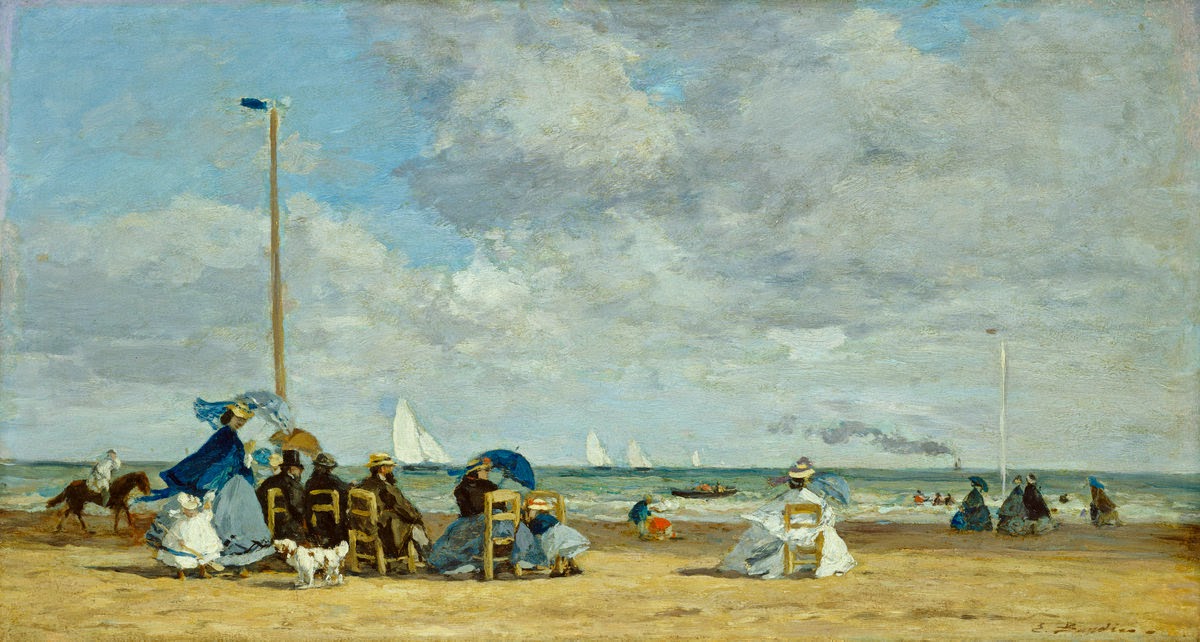
Visconti and his cinematographer Pasqualino De Santis created beautiful images of the beach that are reminiscent of the paintings of Eugène Boudin, with ladies’ parasols clustered by the edge of the sea and their draperies fluttering in the breeze off the Adriatic. 

On the Beach at Trouville, Eugene Boudin, 1864
Still from Death in Venice, 1971

The movie is based on the short novel by Thomas Mann of the same name. This is how Mann describes Aschenbach’s first morning on the Lido beach:

“The shallow grey sea was already gay with children wading, with swimmers, with figures in bright colors lying on the sand-banks with arms behind their heads. Some were rowing in little keelless boats painted red and blue, and laughing when they capsized. A long row of capanne [huts] ran down the beach, with platforms, where people sat as on verandas, and there was social life, with bustle and with indolent repose; visits were paid, amid much chatter, punctilious morning toilettes hobnobbed with comfortable and privileged dishabille. On the hard wet sand close to the sea figures in white bath-robes or loose wrappings in garish colors strolled up and down.  A mammoth sand-hill had been built up on Aschenbach’s right, the work of children, who had stuck it full of tiny flags. Vendors of sea-shells, fruit, and cakes knelt beside their wares spread out on the sand.”    
Visconti’s movie is a faithful adaptation of Mann’s story except that in the book Aschenbach is a writer rather than a composer. And his reason for going to Venice is a growing fatigue with his disciplined writing life, which has made him feel oppressed by the “care and duty to create.”   
"He thought of his work, and the place where yesterday and again today he had been forced to lay it down, since it would not yield either to patient effort or to a swift coup de main. Again and again he had tried to break or untie the knot – only to retire at last from the attack with a shiver of repugnance. Yet the difficulty was not actually a great one; what sapped his strength was distaste for the task, betrayed by a fastidiousness he could no longer satisfy. In his youth, indeed, the nature and inmost essence of the literary gift had been, to him, this very scrupulosity; for it he had bridled and tempered his sensibilities, knowing full well that feeling is prone to be content with easy gains and blithe half-perfection. So now, perhaps, feeling, thus tyrannized, avenged itself by leaving him, refusing from now on to carry and wing his art and taking away with it all the ecstasy he had known in form and expression. Not that he was doing bad work. So much, at least, the years had brought him, that at any moment he might feel tranquilly assured of mastery. But he got no joy of it – not though a nation paid it homage. To him it seemed his work had ceased to be marked by that fiery play of fancy which is the product of joy, and more, and more potently, than any intrinsic content, forms in turn the joy of the receiving world.”  
The unspoiled perfection of Tadzio brings back to the jaded writer the "ecstasy" that makes a book (or symphony or painting) resonate with an audience and fills them with the same joy with which the book was created. Unfortunately for Aschenbach, the cholera overtakes him before he is able to put this new passion into his work. He dies in his deck chair with his face turned towards Tadzio who, standing waist-deep and sunlit in the glittering water, "pointed outward as he hovered on before into an immensity of richest expectation." 


Friday, July 18, 2014

The History of Yesterday

A cameraman filming a masked IRA gunman, 1972 (courtesy of the BBC)


I’ve recently been rereading and editing my first novel, The Province of the Imagination. It’s set in the mid-1980s in the thick of the Troubles in Northern Ireland. It draws on my own brief experience in Belfast as a journalist at that time, though the heroine – Sandie Gillespie – is much braver and more successful than I ever was. 


I wrote the novel around the time that Senator George Mitchell was bringing together the warring parties in a peace conference that culminated in the signing of the historic Good Friday Agreement in April 1998. By the time I sent the novel out to agents and publishers, they turned it down because “the Troubles are old news” and “people are tired of hearing about it.”  


So now, more than 15 years later, I am getting ready to send the manuscript out again, but this time as a historical novel. Yes, the 1980s are now officially history. And it shows in the smallest details in the novel – the need to find a phone box, the unlocking of each car door separately with a key, the typing of a script on a bulky typewriter, and the total absence of computers, cell phones, the Internet, social media – all the technological changes that have revolutionized the world in the 30 years since 1985.


Journalism was a matter of old-fashioned shoe leather and face-to-face interviews with no DNA matching or worldwide information databases. Looking back, I remember I didn’t even own an answering machine, even though I was getting calls from Cabinet Ministers and other senior politicians at my home. This is the low-tech world in which TV reporter Sandie Gillespie, nursing a broken heart, and her over-protective producer Bob, who’s in love with her, try to find out who assassinated the leader of Sinn Fein, the political wing of the IRA. As they weave their way through the labyrinthine and violent political world of the Province of Ulster in the never-ending rain, no one will give them a straight answer and they discover that nothing and no one is quite as it seems.