Tuesday, July 10, 2012

A Place of Extremes

Sun and rain clouds over Moorea on the ferry to Tahiti, December 2007

Here in the Washington D.C. area we have just emerged from the grip of a brutal heat wave with temperatures above 100 degrees F and sky-high humidity. Meanwhile, my other country across the Atlantic has had the wettest June since records began with no end to the deluge in sight.

Both kinds of extreme weather are hard to handle while you’re living through them, but both can be a powerful atmospheric force in fiction. For sheer tropical heat, you can’t beat the last section of Evelyn Waugh’s A Handful of Dust when Tony Last goes on an expedition to the Brazilian jungle to try to forget his cheating wife. And for a good British drenching rain, there is the passage from Charles Dickens’ Great Expectations describing the wretched weather on the night that Magwitch comes back into Pip’s life “...stormy and wet, stormy and wet; and mud, mud, mud, deep in all the streets. Day after day, a vast heavy veil had been driving over London from the East, and it drove still, as if in the East there were an Eternity of cloud and wind.”

My own fiction has ranged from the cold incessant rain of Belfast in The Province of the Imagination:


As she had expected, the cemetery seemed to be deserted. She paused after locking the car to turn up her collar, savoring the chance to be away from inquisitive eyes. There was a light in the window of the lodge by the car park, and Sandie imagined a pair of gravediggers straight out of Shakespeare brewing up a pot of tea. Who would want to be out digging graves in this eternal, bone-crushing damp, she thought as she walked through the wrought-iron gates. It was drizzling, but she had deliberately left the umbrella in the car. She felt wet both inside and out, drenched to the core. The fine drizzle clung to the ends of her hair like a bridal veil.

.....to the furnace-like temperatures of the India plains in the first book of Albion’s Millennium: 


The horizon was already blurry with heat and each step of his horse's hooves kicked up a puff of terracotta-coloured earth. He rode past scrubby bushes with leaves caked in red dust, springing out of the bare rock of the ridges that broke the surface of the plain. Ahead of him, swirls of dusts would arise and sink, stirred up by nothing that was visible to the naked eye. In the distance, he could just see the hazy outlines of the great swathes of rock of the Amarapuna Hills like a row of sleeping elephants, their hides ranging from grey to dun to ochre and then to almost amber as the sun slowly encroached across them. Vultures circled around high above on some bare wisp of breeze that could not be felt at ground level. Makepeace felt sweat pool inside his hat and roll down his back and soak into the waistband of his jodhpurs. There were dark patches on his horse's hide. The cicadas were so loud it seemed like the earth itself was making noise, a hissing and rattling that crescendoed to the pitch of a scream before subsiding only to begin all over again.

But only in Tahiti in the rainy season have I ever experienced both kinds of weather in the exact same place and time – scorching heat, soup-like humidity, and then torrential, monsoon-like rain that felt both hot and cold on the skin. Thus did the extremes of my two Midatlantic climates come together with a vengeance in the far reaches of the South Pacific. 

Wednesday, June 27, 2012

The Wild Nights of June

Die Jungfrau (The Maiden) by Gustav Klimt (1862-1918)

Before the lovely month of June is over with its steamy days and firefly nights, I want to put in a plug for a wonderful novel called Centuries of June. Full disclosure requires me to tell you that the author, Keith Donohue, is a friend and neighbor and that I once profiled him for Bethesda Magazine. But that is neither here nor there when it comes to my admiration for this book. Keith was already the author of two remarkable earlier novels, Angels of Destruction and the bestselling The Stolen Child, so much was expected of novel no. 3 – and much was delivered. Reviewers have called it “vivid,” “ambitious,” “impressive,” and a “tour de force.” 

Be prepared for something that’s unlike anything you’ve ever read before. The Washington Post called it “part ghost story, part psychological mystery, and part vaudeville show,” and that’s just a taste of how the book refuses to be pigeonholed.

Waking up at exactly 4.52am on a warm June night, the narrator pads his way to the bathroom, falls and smacks his head open. When he recovers enough to sit up, he discovers an old man who could be his long-dead father – or maybe Samuel Beckett – sitting on the edge of the tub. And it gets curiouser and curiouser from there.

When the narrator leaves the bathroom to fetch his strange guest a glass of whiskey, he pauses at the top of the stairs, thinking he hears a sigh “so delicate it may not have been a sound at all, but only the thought or memory of a whisper from some other point in time and some space beyond the walls or perhaps within the walls themselves. I could not tell whence it came, so I delayed my trip downstairs and sought its source.” And he opens the door to the spare room and finds eight naked maidens entwined on the bed.


“They appeared at once and altogether, a floating cloud, flower and flesh, jumbling of limbs, hands, a bare breast, the curve of a hip, a half-dozen bare arms, skin and hair of assorted hues, some beribboned with garlands, others loose and unbound. Lips, faces at odd, unnatural angles. Eight women in a tangle, pretzeling bodies at rest. All but one of their faces were turned my way. One pair of eyes opened. Another blinked in my direction. The patterns on the blankets shimmered like colored glass in a kaleidoscope, stirring to life. The colors moved like a wave, the blankets parted like the sea. Another woman cracked alert and stared at me, caressed the shoulder of her neighbor as if to wake her, and I stepped back from the threshold and quickly shut the door. Someone sighed again, but I was not sure if this time it was not me.”

Now who wouldn’t want to find out what that was all about?

One by one the women show up in the bathroom and regale the narrator and the strange old man with their stories, which are witty, moving, disconcerting, sexy and everything in between. Like a Hydra-headed Scheherazade, they lead the men - and us - on a feminist romp through centuries of American history. And between each story, we return to the magical bathroom where the time is always 4.52am, the space is never too small for its ever-expanding population, and we become increasingly, uneasily aware that some sort of reckoning is in store for the mild-mannered narrator.

The last half dozen pages of “Centuries of June” are some of the finest and most moving I have ever read, and I hope that one day I manage to write anything half as good. As the firefly dusks give way to the hot nights of the cicadas, go buy this book and let yourself be transported.


Wednesday, June 20, 2012

No one Left and No one Came


In preparing my recent post about W.H. Davies, who was a protégé of the Welsh poet Edward Thomas, I was reminded of the sad story of Thomas and his wife Helen. The couple had a long, deep, and passionate relationship, marred only by Edward’s descents into depression. After he was killed on Easter Monday in 1917 at the Battle of Arras, Helen wrote two beautiful memoirs of their lives together, As It Was and World Without End, published together as Under Storm's Wing. I have been reading them this week, and I defy anyone to read Helen’s description of the end of Edward’s last leave without tears. 

While Helen worked hard to make a home for Edward and their three children in a succession of small country cottages – cleaning, sewing, baking, growing vegetables – Edward was toiling away at the journalism work that made him little money and kept him from his writing. How many writers can empathize with that? His moods and his rages against Helen are harder to read about, though she waits them out every time, never rebelling or resisting.


“Another dreadful day. The children avoid him as much as possible, and are afraid to talk at meals. He knows it, and it is fresh torture to this tortured spirit. He tries to make them say they hate him, and they cry and will not. A black gloom is over the house. I dread his going to the study; I dread his coming back. I feel my face stiffen into deep lines. I am possessed with fear. He speaks little, but what he says is said to hurt me and doubly hurt himself. I keep myself hard at work, for if I stopped I should become physically incapable, as spiritually I am paralyzed. I should just sit and brood. My soul is in the dark and loneliness and agony with him, but my body has to work, my tongue to make conversation with the children. I drag through it all as if I were weighted with chains.”

Helen’s sweetness and infinite patience was what brought him out of these terrible punitive moods of despair and self-loathing, and when they lifted, Edward was once again a loving husband and father – and once more able to write.

After his death, Edward Thomas came to be regarded as one of the greatest poets of his talented generation, particularly in his treatment of nature and the countryside of England and Wales. His most famous poem is Adlestrop – inspired by moment at a rural English station railway on a late June afternoon. (If you click on the poem’s title, you can hear the poem read by Thomas’s fellow Welshman, the actor Richard Burton.)


Adlestrop
Yes. I remember Adlestrop—
The name, because one afternoon
Of heat the express-train drew up there
Unwontedly. It was late June.


The steam hissed. Someone cleared his throat.
No one left and no one came
On the bare platform. What I saw
Was Adlestrop—only the name


And willows, willow-herb, and grass,
And meadowsweet, and haycocks dry,
No whit less still and lonely fair
Than the high cloudlets in the sky.


And for that minute a blackbird sang
Close by, and round him, mistier,
Farther and farther, all the birds
Of Oxfordshire and Gloucestershire.


Wednesday, June 13, 2012

The Doors of Communication


Readers of Midatlantic may have noticed that you can now be informed via email every time I put up a new post. Just type your email address in the “Follow by email” box on the right and click on “Submit.”

Also, I know it can sometimes be tricky to leave comments on the blog itself so if you ever wish to send me feedback on any of my posts, please feel free to contact me at Fionamack@aol.com.


Saturday, June 9, 2012

Smelling the Roses

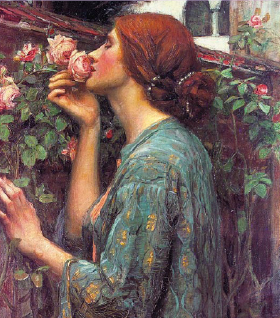
“My Sweet Rose” by John William Waterhouse (1849-1917)

Embedded as I am in a seemingly endless season of 7-day-a week editing, I’ve had little time to enjoy the finer things of life recently so I thought I’d share with you a poem on exactly that subject.

It was written in 1916 by the Welsh poet, W.H. Davies (1871-1940) and, in all its simplicity, must have struck a chord because it has been much anthologized. Davies’ life was one of extremes. Born in the port city of Newport in Monmouthshire and raised by his seafaring grandfather, he was a rebel all his life. Between 1893 and 1899, he rode the rails around the United States and Canada until his lower right leg had to be amputated after it was crushed under the wheels of a train. He returned to Britain and lived rough on the streets in London till his poetry caught the eye of fellow Welsh poet Edward Thomas, who became his mentor. After the publication of The Autobiography of a Super-tramp, his memoir of his time spent as a hobo in the US, Davies began to associate with such literary icons as D.H. Lawrence, George Bernard Shaw, and Edith Sitwell. Yet at some point between these two extremes of his life, Davies was struck by how rarely modern man stops long enough to smell the roses. For myself, I cannot wait till I’m once again able to “stand beneath the boughs, and stare as long as sheep or cows."

Leisure

What is this life if, full of care,
We have no time to stand and stare.


No time to stand beneath the boughs
And stare as long as sheep or cows.


No time to see, when woods we pass,
Where squirrels hide their nuts in grass.


No time to see, in broad daylight,
Streams full of stars, like skies at night.


No time to turn at Beauty's glance,
And watch her feet, how they can dance.


No time to wait till her mouth can
Enrich that smile her eyes began.


A poor life this is if, full of care,
We have no time to stand and stare.


William Henry Davies

Friday, June 1, 2012

Happy and Glorious


This weekend the United Kingdom will celebrate the 60 year jubilee of Queen Elizabeth II. The celebrations will rise above the pettiness of old scandals associated with the Royal family, not to mention the constant speculation about when William and Kate are going to breed.  This is a time to remember how much the country has changed since 1952 – and how much in other ways it has stayed the same. There will be street parties around the land just as there were on Coronation Day and the same immaculate pageantry will remind the world that this elderly lady is the symbol of Britain’s long sweep of history since Alfred the Great. Plus ça change, plus c'est la même chose.

Here on Midatlantic, I mark the occasion by posting this lovely drawing by Norman Hartnell of the Queen’s Coronation dress. The gown incorporated the symbols not only of England, Scotland, Wales and Northern Ireland (the rose, the thistle, the leek and the shamrock) but the symbols of the Dominions – as they were then called. It included the Canadian maple leaf, the Australian wattle, the New Zealand silver fern, and the South African protea as well as the lotus flower for India and Ceylon (now Sri Lanka) and wheat sheaves, cotton, and jute for Pakistan.

And I draw your attention to this short but very beautiful anthem – O Taste and See, a setting of Psalm 34 – written for the 1953 Coronation by that most British of composers, Ralph Vaughan Williams. I defy you to listen to it and not think of the antiquity of Albion epitomized by that little old lady in the crown.

Wednesday, May 23, 2012

Getting it Right

The gate to Pitgaveny, the house near Elgin owned by John Brander's father 
  © Copyright Des Colhoun and licensed for reuse under this Creative Commons Licence
All families have apocryphal stories that are told and retold at family gatherings and handed down through the generations. As in a game of “telephone” or “Chinese whispers,” they often get altered with each telling until the final version is very different from the original incident that was the germ of the tale.

My own family has anecdotes like that, many passed down through my paternal grandmother who was the world’s greatest storyteller. This kind of story is important because it takes on the imprimatur of each generation that passes it along. This makes it “true” in the sense of being faithful to the evolution and spirit of the family in question.

However, it does not necessarily make it accurate.

Historical scholarship is all about finding out what actually happened. This means uncovering every last scrap of documentary material that has survived and then coming to conclusions on the basis of that evidence. There will always be gaps in that body of material of course, and no historian or biographer would suggest otherwise. But every story told must have its foundation in the evidence. Wishful thinking has no place in historical research.

Here’s an example. For years, I have been trying to authenticate a wonderful story about John Brander (Princess Titaua’s first Scottish husband) that someone once told me but for which he was unable to give me a source.

The story is that young John Brander, born the illegitimate son of a Scottish laird, saved his much older half-brother – the legitimate heir to Pitgaveny – from drowning. In gratitude, the older brother is said to have given John a reward of £400, which John used to finance his emigration to California where he is supposed to have made his first fortune selling equipment to the Gold Rush miners.

It’s a great story – encompassing drama, heroism, adventure, and success – so I’d love to include it in Children of Eden. But is it true?

Not one word of it, at least as far as I’ve been able to discover.

To my great disappointment, I’ve been unable to find a single shred of evidence to substantiate the saved from drowning part. That doesn’t mean it didn’t happen - just that, until I can find an account in a contemporary newspaper or letter, I cannot be sure that this incident is anything more than a Scottish urban legend.  

As for the part about Brander’s half-brother giving him the money, I’ve found nothing to validate that either. What I do know is that John Brander’s natural father left him £1,000 in his will when he died in 1826. In modern terms, that would be around £50,000 or $78,700 – in other words, plenty of cash with which to start a new life anywhere in the world.

And it also seems unlikely that John Brander ever set himself up in business in California. According to shipping records, he arrived in Sydney in July 1840 from Liverpool at the age of 23 and began trading in various goods, first with European settlements in New Zealand and then gradually extending his range to Tahiti. It is true that later his schooners made regular visits to the port of San Francisco with shipments of Brander’s oranges, pearl shell, and copra but not until after the Gold Rush is generally thought to have burned itself out.  

It may not be as good as the rescue from drowning story but it’s the truth - or at least the extent of the truth as can be unearthed from the surviving records. And that’s what I’m committed to telling in Children of Eden. But I also fully acknowledge the importance of those family anecdotes that morph and meld their way into myths to be carried forward through the generations. Stories are essential to the human spirit however they manifest themselves.